Showing posts with label math. Show all posts

24 September 2013

thing-a-week 37 and 38: Vedic square experiments

For weeks 37 and 38, I experimented with the Vedic square.

I've always admired the geometric designs in Islamic art and architecture but figured that the math involved would be too complicated to learn. But, another recent Good Job Brain episode unlocked at least one secret for me by telling me about the Vedic square.

You can go ahead and read the brief Wikipedia article article about it, but the Vedic square is a 9x9 table that shows digital roots — the remainder of ((x * y) / 9) — instead of multiplication products:

Thanks, Wikipedia.

If you draw lines connecting all the same digital roots in the square, you can already make some pretty neat shapes.

But you can also make simple, elegant designs if you take a whole row from the square, use the numbers in that row as measurements, and keep turning your paper at a certain angle until you get back to where you started.

Of course, those instructions might be difficult to understand without an example, but I'll get to those in a bit; please bear with my nerding out a little longer.

I tried to go all pen-and-paper for this, but it turns out that my protractor is inexact, so I put these black-and-white drawings together on a computer. Even then, I had trouble getting everything to line up just right, so I really have to hand it to the first artists who worked with these measurements by hand.

Whatever angle you choose, it looks like you'll get yourself nine possible shapes. I first went with all 90-degree angles, and all but one row led me to produce these swastika-like shapes. This is the one with sequence 1 (1, 2, 3, … , 9):


Sequence 5 (5, 1, 6, 2, 7, 3, 8, 4, 9):


Sequence 7 (7, 5, 3, 1, 8, 6, 4, 2, 9):


Sequences 2, 4, and 8 produced the same patterns, but in the reverse direction. Sequences 3 and 6, I felt, were too simple — four connected or overlapping rectangles in the same turning shape. The one row that didn't produce such a shape was row 9, which gave only a square.

At this point, I could appreciate for myself how the numbers of the Vedic square could be kind of cosmic, or why people might see them as holy, magical, or divine. The sequences are so simple, but if you follow them with one unbroken line, you create a shape that turns forever, and you always end up back where you began.

If you think this says something about the nature of life and the universe, then you'll probably find this either depressing or comforting.

I did two more designs by turning at a 45-degree angle. Here's sequence 2:


and sequence 5:


Of course, these things just beg to be colored, so I also printed out this last one and used it as a template for this:


To my frustration, of course, doing this with paper wasn't as neat as it was on the computer. But, I like it enough to want to make more. And I still have other angles to try.

22 February 2013

thing-a-week 8: flexagons + quick tutorial

I wanted to do something with the grocery bags that are piling up in my place, so I made some flexagons.

Wikipedia says that these are "models", though I don't know what they're models of. I just think of them as paper toys that change faces when you fold them a certain way.

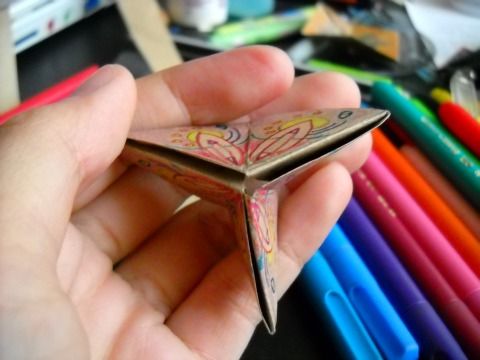
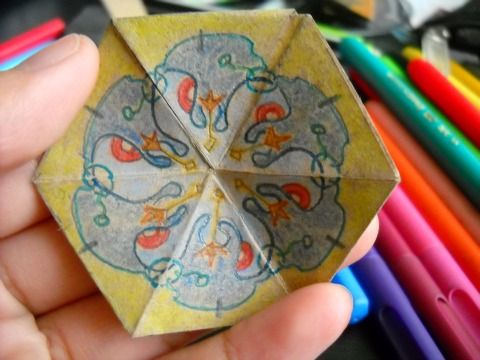
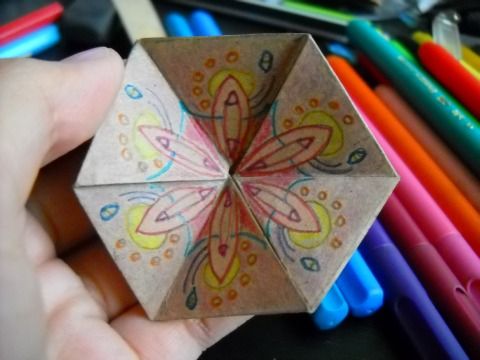
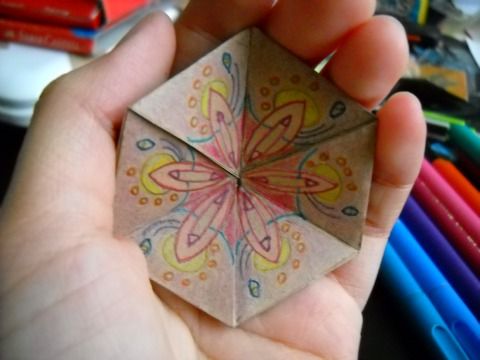
Here's my flexagon with abstract, bacteria- and coral-inspired designs:

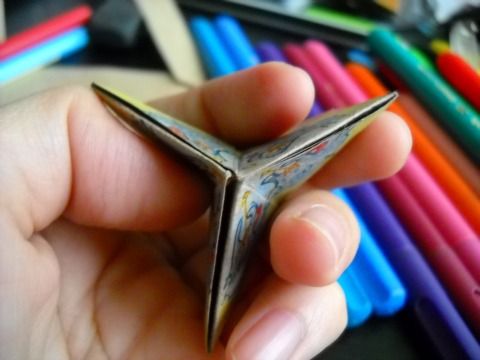
Face 1…

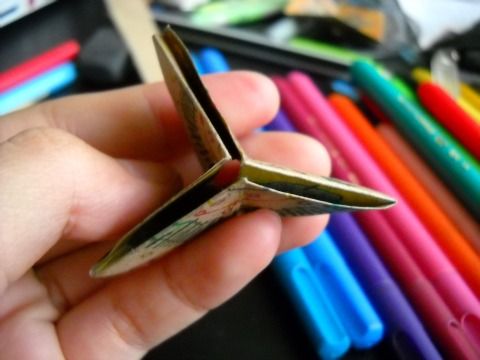
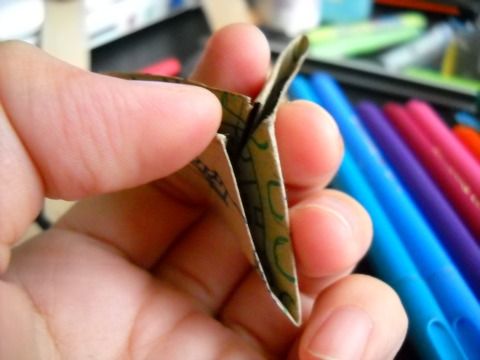
…folds back to show…

…face 2, which…

…folds back to show…

…face 3, which, …

…when folded back…

…brings face 1 back again.

I used pencil and markers for the lines and colored pencils for the fills.

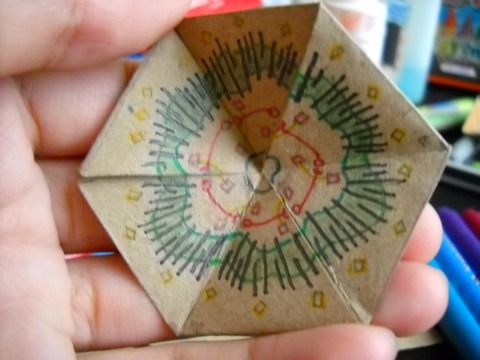
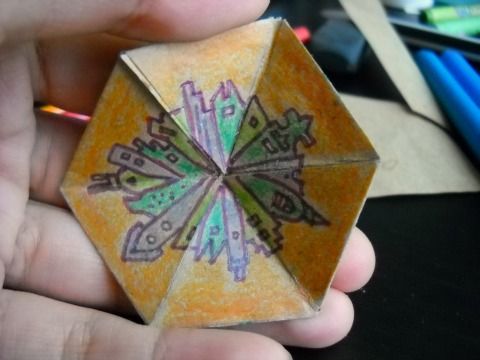
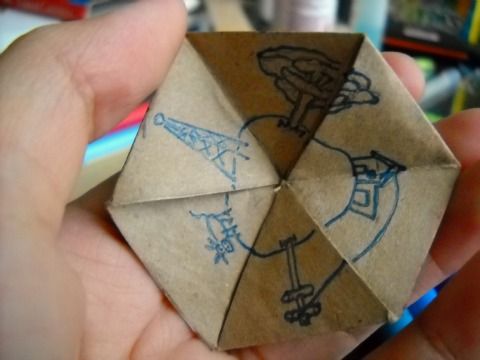
Originally, I wanted to do a "town and country" theme, so I came up with the flexagon below. But, I didn't color it all the way, because I wasn't happy with the way the crayon looked on brown paper.

Skyscrapers for face 1…

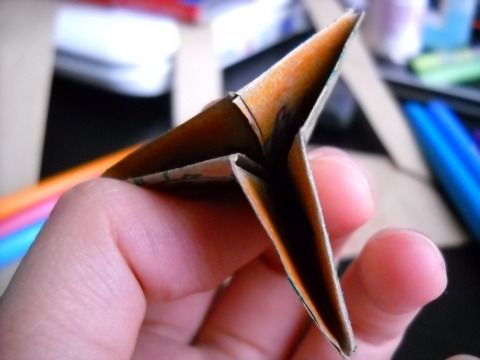
…fold in to show…

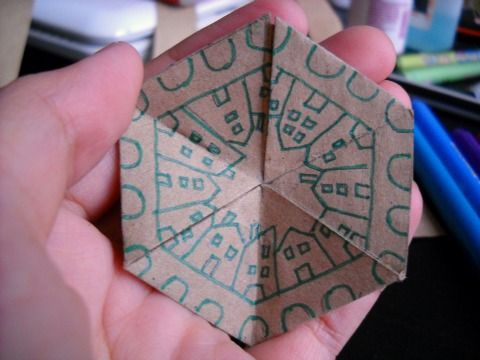
…townhouses on face 2, which…

…folds in to show…

…a tiny farm planet on face 3 (which folds in to show face 1 again).


Now, flexagons are pretty easy to make. The ones in this post are actually called trihexaflexagons, because there are three faces. But, you can make flexagons that show even more faces; I've seen dodecaflexagons.

Flexagon.net is a pretty good place to start. You can either download a template from there and print it, or draw the templates manually like I did.

If you do make a template by hand, I suggest using a protractor to make sure that each triangle is equilateral. I also had to use the Pythagorean theorem to figure out the height of each triangle.

If you're impatient to give this a try but don't have a printer and don't want to use math (boo!) my triangles had these dimensions:

length of side = 3 cm
height = 2.6 cm

For a trihexaflexagon, draw the triangles in two lines like so: (PDF). Follow the folding instructions there as well. I wrote the guide letters really tiny in the corners and then erased them after the glue dried.

Once you're ready to design, decide whether your flexagon will fold in or fold back:

Folding in: Face 1 goes inside; face 2 appears outside.

Folding back: Face 1 goes outside; face 2 appears inside.

If you fold one face in and one back, at least one face will come up inverted (of course, that could be just what you want).

UPDATE (022613): After going home and checking the flexagons, I realized that what I really wanted to advise you against was designing one face, flipping it over, designing that, and then folding in/back and designing the third face. That's what gets you an inverted flexagon face. Fold in or back, it doesn't matter, as long as you fold before you design.

Design each face in the order you want. The design for each face is up to you, of course. Last year, I gave a flexagon instead of a birthday card. I also read about a teacher who taught his students to make flashcards out of flexagons, with each face featuring a different word and definition.

Let me know if this post is useful to you or if I could clear it up somehow.

So far, I've made only trihexaflexagons. I tried a tetrahexaflexagon once but couldn't figure out how to get the fourth face to appear. I guess that's something for another day.