Showing posts with label drawings. Show all posts

30 January 2014

Imelda's House (with attempts at illustration)

I dreamt that Calvin couldn't sleep, so I watched him move from panel to panel, painting on the faded red walls of a room with a black-and-white checkerboard floor.

Calvin looks older here, but in the dream, he was about six or seven years old.

His teacher caught him and set him at a bunch of other activities with the other kids. Calvin had a fun day and was excited about the school sleepover.

But when it was time to sleep, and the other kids had all climbed into their beds, on either side of the teacher's big bed, Calvin felt a panic. So he climbed into the teacher's bed, which woke her. She was angry about it, but when she saw that he was crying, she said, "Don't worry, Calvin, there is something you can do." And she pointed at something off-panel; in my mind, it was a book.

I was adjusting photographs for uploading, and one photo of some kind of evergreen caught my eye. It wasn't a pine — the bark was different — but it had needles. I had planned to crop the photo around the tree, with the house — my house, but not in Kalsangi; someplace between the edges of "Christina's World" and the edge of a forest, of which the evergreen was one tree to say, "You are near a forest" — in the background. But as I zoomed in on the photo, I was drawn closer and closer to the tree, until it filled my screen. The bark was gray-green and had lichens, and the needle-leaves looked feathery, like frost patterns on glass, and almost soft. I saw that no matter how close I zoomed in on the trunk and the leaves, I could still make out the shadow of the house behind them.

There was a man, David. He was not Calvin, but he was like Calvin. I was him, and I also watched him, the way you can in dreams. No more panels here.

In his house, David played with his children, two sons and a melancholy daughter — his youngest. And then his children were gone, and David in his dark brown suit with a white shirt went from his son's room, crossed a sort of red hall with a checkerboard floor and some arches in the walls, and went into his daughter's rom. He was sorry he hadn't spent enough time with them.

The hall in David's house. The pillars at the top are supporting a black or dark brown roof; the space between the pillars is open for air to come in.

Both the children's rooms were a mess. The daughter's room was all papers and paints and books, scattered all over the place. She was collecting these books by a guy whose last name was Funk (first name Paul?). His style was Shaun Tan meets M.C. Escher. One book she didn't have yet — there was a long list, and she had only one or two — was titled, "Imelda's House."

David found a diary where his daughter had scribbled things about him. (David talked aloud.) On one page, the word "Dad" changed before our eyes:


and David realized that his daughter had learned something about him.

On the opposite page, the left-hand page, some pencil writing about her dad had been erased and then covered by other pencil writing about her dad. David erased this, and the old writing reappeared, and he saw that his name was not David [Lastname] but David Davies. Davies was underlined three times.

And then David was in another town, in its tiny, Shaker-style, dimly lit records hall. Afternoon sunlight came in from outside through high slats. He was holding the same book his mother must have held years before — the one that said her name was actually Gwendolyn G[...] and not Gwendolyn [Lastname]. And he was in despair, in a kind of panic, because how many books were there left to go through, and when would he finally find out who he really was?

David went into the next room, the hall in his home, faded red with the checkerboard floor. As he cried, a great clock came down from the ceiling. Its circular face was white, and it had the peaked square top of a lantern. Its body was thin and silver, like a tall designer lamp's, and the clock face bobbed gently at the end of it. The silver shone yet was not smoothed down; it was as if someone had stretched that metal out by hand and then left it like that, covered with the impressions of the insides of his fists.


Above the clock, there was a swirling, tornado-like vortex and some thunder and lightning. The clock said to David to not be afraid; he could find the answers if he sought them.

David went up with the clock into the vortex, and then they were in a great library. It was a messy library; the shelves were out of order, and there were books scattered on the floor. The room David and the clock had entered was rectangular and had three walls, all lined with bookshelves from floor to ceiling, plus balconies. The two long walls had doorways to other rooms. The center of the room had a wooden staircase that dropped down to more rooms. Past the staircase were reading tables, and past those reading tables, where the fourth wall would have been, was a view that looked a lot like Escher's "Gallery" or "Other World", but with blue and green gardens instead of outer space beyond the arches.


There were other people in the library. They scrambled frantically from shelf to shelf, grabbing books, poring through the pages, filling their arms, and looking for their answers. Men, women, and children, young people, old people — all kinds of people rushed this way and that with their stacks. David quickly joined them, and suddenly, I was outside David. I wasn't on a quest like him and the others; I was just a visitor. I looked at an old man with a long white beard at one of the reading tables, and I wondered how long any of these people would be here, knowing that there could be any number of rooms and staircases and books.


The room was faded red, with a checkerboard floor. In front of the shelves were decorative white metal trellises. I approached one of the shelves on the opposite wall. I saw that all the books were fictional, and there were volumes and volumes and series and series by so many different authors from so many thousands of years. I saw two series, one red and one green, but both with a picture of a man in a Martin Luther getup on the cover. I wondered how long it would take someone to piece together all the clues in all these books and what sort of answer they'd get in the end.

One of the books I saw.

I saw a shelf full of those books by Funk, that author David's daughter had liked, and since I had liked the illustrations, I decided that I'd read the books. I wonder if there was anyone else there who was just reading for fun and not looking for answers. I reached for Funk book No. 1 and saw that the first illustration was of a place like this library, with a checkerboard floor, people looking at shelves and books, and an arched garden in the background. Among the people in the illustration, there was a man who looked like David and a girl in a red dress that I had seen when we'd entered the library.

I tried to read the first paragraph and immediately found it difficult, the way you sometimes read the same paragraph several times over without anything in it sinking in.

So, I showed the book to the clock, which was going around with a ring-bound book shaped like a red ribbon or arrow. The clock was putting the shelves back in order. I asked it, "Why can't I read this book?" And it took the book from me and flipped through the pages of its red book — which was strange, because the clock didn't have hands, except for the clock hands on its face, and I can't even remember what time it showed. After finding the right page, the clock said, "Today is September. It is not the time for F. You'll have to try another time. Here, try [...]." And he left me by another shelf to put the Funk book back where I'd found it.

The clock's "book". I'd forgotten to draw it, so I made this drawing in GIMP. Now that I think about it, the pages look like the hands of a clock.

On that shelf, I saw another Funk book, possibly misplaced. It wasn't like a regular book, but when I saw it, the word that came to mind was "book". It was called "Imelda's House." It was shaped like a cake tower, like something out of a Giorgio de Chirico painting, and instead of pages or a cover, it had little doors in the sides that you could open, to see dioramas of things inside the building. I don't remember any of the scenes I saw except the one behind the biggest door: a library with decorative white trellises in front of the shelves, faded red walls, and a checkerboard floor, and with the clock standing over a pile of books on the floor and with the gray cotton vortex above its head.

"Imelda's House," by Paul(?) Funk

After this, I woke up.

--

I guess I should lay off the surrealists for a while.

12 August 2013

thing-a-week 28, 29, 30, 31, 32: Excuses and My Lumpy Heart

I'm truly sorry that I haven't been able to keep up this series in the past month or so.

I could blame this on several things. It took me a couple of weeks, for instance, to find and then move my things into a new apartment. That was last month, though, and my things still aren't unpacked. I'm not actually living in the place yet because the bolts that hold my bed together got lost in the last move, so I'm still going through hardware stores and looking for right-sized replacements. And in the meantime, I'm still lodging with friends, making a longer commute, and being tired.

I wrote in June that I liked the extra time that my new work hours gave me, but these days, I spend more of that extra time just spacing out, emptying my head from the night before and recovering just enough for the one ahead.

And while I tell myself that I should be glad for the rest, I also know that making things helps me to rest, and I just haven't made enough time to make things.

For week 28, I made two flexagons with abstract designs. I actually worked on them at the office while waiting for each day's editorial meeting, cutting and folding and drawing a little each day.

Unfortunately, they just disappeared from my desk one morning or evening. Either I actually slipped them into a book or notebook to work on elsewhere and then simply lost them, or someone found them interesting and took them, like they took two of my modular hassocks.

As for week 29, sorry to subject you to more of my abysmal drawing skills, but all I have to show for that week is this drawing of a land hermit crab.


Sometimes, Cris and I listen to trivia podcast Good Job Brain in the car together, and one episode explained how land hermit crabs swap shells. We happened to be surrounded by SUVs then, so I started to imagine a not-so-distant future where land hermit crabs are hulking monsters. They use hollowed out cars as shells and trade up as they grow, from VW beetles to hummers and even buses and container vans. For entertainment, people go to arenas to watch the crabs fight for bigger shells.

For this drawing, I used a photo of a crab as a reference but was too lazy to put more work into the SUV. Perhaps once I have a story fleshed out, I can ask a more talented friend to illustrate.

Week 30 was the worst. I was supposed to complete my Processing project that week but ended up resigning the whole course. While I liked my project idea, the course itself no longer held my interest; its objectives were more and more clearly different from my own. So, I decided to just remember the sunk cost fallacy, quit the course, recover from my burnout, and save my project for another day.

All I have to offer for week 30, then, is a screenshot of some of the code I worked on while I was still working on it.


I don't know if you'd count the code, so I don't know if you'd count what I made in week 31, either.

I recently joined a Facebook group of fellow former Glitch players. I thought my stay wouldn't be long, but it turns out that there are many other people who also still feel sad that Glitch is gone, however silly it might seem to have so much feeling for a closed computer game. There's just nothing like it out there.

One day, a game developer invited the group to test a new game, Manyland. While the game wasn't going to be anything like Glitch, the developers had heard about the culture of Glitch players and were hoping we could bring some of that to the game.

So, week 31 saw me testing Manyland when I could. I can best describe it as a two-dimensional LEGO, though Minecraft players say it's like Minecraft. It is lots of fun but kind of lonely; perhaps due to lack of other players and a map, it gets existential fast — where am I? Why am I here? Where does this world end? If I build a platform far enough, will I go all the way around to where I began?

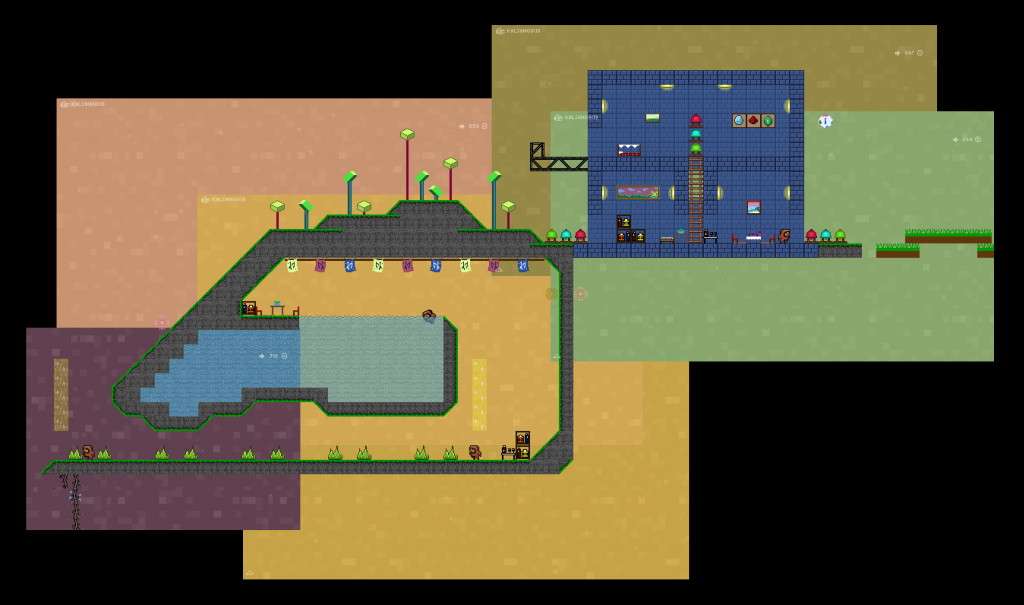
One of the first things I built was this simple brick box house with an underground swimming cavern and tiny wine cellar:


You can actually change the color of the sky, and the colors blend as you move across the screen, but when you take screenshots, you get just the color of the sky (and any translucent things, like water) based on your current position. The little gnome-like person in this assembled screenshots is actually me.

If you prefer something more traditional than code or digital building, then week 31 was also when I started work on the craft for week 32:


Week 32 was a nice return to paper. One of the secretaries at work used to spend her free time on complex, three-dimensional paper models of video game and cartoon characters. I wanted to try one of those but didn't want just any model. When I saw the Paper Torso by Horst Kiechle, it felt best for me.

I printed out the template of a human heart; the pieces took up about eight-and-a-half sheets of letter-size paper, and I did the cutting and folding in my spare time. I then glued all the pieces together in about three hours yesterday.

Photos of the resulting heart are below. It is pretty lumpy for several reasons: I cut next to some of the lines and not on them, and not all of my cuts were straight, so some of the triangles did not fit each other the way they were supposed to. I also used regular bond paper, which absorbed moisture from all the rain we've had lately and thus made the whole thing softer and easier to dent. While assembling the valves, I found I'd inverted a section and so had to push and pull it without tearing the whole thing apart.

But, it's mine, and I am happy to have made it, lumps and all.

Please excuse the awkward hand poses. I needed to keep a hold on the heart, but not too tightly, or I would have crushed it.


This project was lots of fun but also kind of weird. I knew what it was supposed to look like, and I knew that it was taking shape, but only when I had the whole thing in my hands did I think, This is a heart. I stood with it in front of a mirror just to see how big it was, and I somehow felt very small, cradling a white paper heart in my palms against my pink shirt.

I am thinking of doing lungs next, even if I don't even know what to do with the heart now.

The heart template is just one in a set of templates to build a neutered human torso. There are more templates on Mr. Kiechle's Paper Torso website; feel free to share with students, crafty doctors, and anybody else who might like the idea of making human organs out of paper.

Other stuff I feel like sharing: this waterfall cabin I built in Manyland, accessible only by falling into the water and swimming down (water is weird in Manyland) and exit-able only by magic wind. Unless you cheat and build ladders or platforms, any other way brings death.


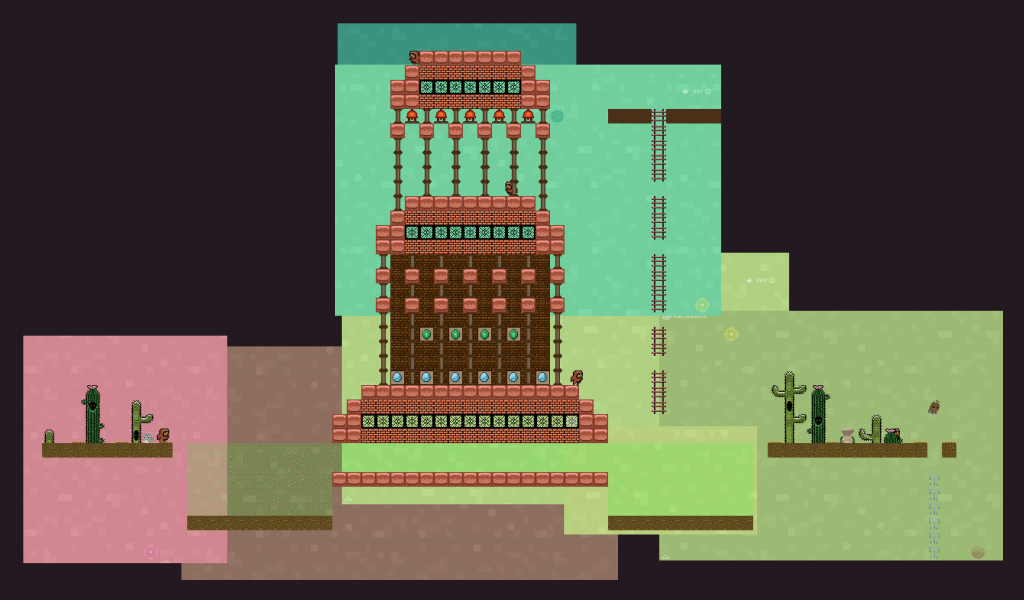
I also built this temple, but in hindsight, the color of the bricks I used makes the whole thing look like something else; something less, uh, temple-y.

The magic wind from the cabin will actually bring you here; you pop out of the gap on the right, next to the cacti.


I don't actually get to play Manyland that often; I only play it at home, and it depends on how I'm feeling. But it is lots of fun, and as the game is still in its early stages, the developers are quite reachable for help, feedback, and bug reports. If any of you get to play, my username is kalsangikid.

02 July 2013

thing-a-week 26, 27: "A Bat Above" (Phase 1)

I was able to fish out my scanner, so for Week 26, you get a scan of a new drawing I made for my Processing project.


I actually like the first drawing a lot more, but I didn't want the drawing I used to be too much like the reference photograph. I might still make another.

For the first time in this series, I'm presenting a digital work. Week 27's craft is the first phase of my Processing project, as submitted. Here also is the project information, just for reference.

The class requires us to either submit two different projects or submit two phases of one project.

DESCRIPTION
This is only the first stage of the project; my final submission will be a simple coin-collecting game.

"A Bat Above" is inspired by Glitch (www.glitch.com), an MMO game that closed late last year. My project imagines what it might be like for the cave-dwelling batterfly, an in-game animal, to emerge from the caves after the game's closing and roam an empty landscape while wondering where all the players have gone.

I want my project to be enjoyed by everyone, though — not just former Glitch players.

At this point, the game doesn't have the coin-collecting mechanics yet. I focused on the design and music — the general look and feel. It's not much, but it's what I've managed to put together so far.

I drew the background by hand, and the background music is a mix I made using sounds from freesound.org. The bat is moved by the mouse pointer.

SCREENCAST


BACKGROUND MUSIC


(The screencast did not capture the music during the demo, so I uploaded the music to SoundCloud.)

REFERENCES
The sound of birds chirping is by hanstimm, who released it on freesound.org under a Creative Commons Attribution-Noncommercial license.

The piano loop is by Erokia, who released it on freesound.org under a Creative Commons Attribution license.

The batterfly sprite is by Tiny Speck, who released it on glitch.com under a Creative Commons Attribution-Noncommercial-ShareAlike license.

The music is played using the Maxim Java API provided by the course instructors.

I referred heavily to the processing.org examples on sprite animation and object-oriented programming.

Last but not least, Will Gallia in the forums helped me figure out how to get the background to scroll.

--
It looks like I forgot to cite Cory Richards, the guy who took the Tsarang temples photo I used as inspiration. I'll have to remember him at the next submission.

The background music and the screencast were firsts for me. Obviously, my sound mixing is kindergarten-level; I just threw hanstimm and Erokia's sounds together in Audacity. The credit really belongs to them.

I hope that by next deadline, I'll have figured out how to capture the in-game sound with the screencast, or how to export the whole thing as a web app, so people actually get to try it.

(I wish I could share some of the projects I made for Python class, but doing so would be considered leakage and might lead future students to violate the honor code.)

23 June 2013

thing-a-week 23, 24, 25

For week 23, I made this simple kirigami model on a sheet of parchment paper about half the size of a sheet of bond paper. I wanted to set it against black paper, but unfortunately, my stuff is still in storage. A problem with my new apartment means I can't actually move into it anymore and will have to find a new place again.

Anyway, I wanted to do something more about interiors than exteriors, and while I don't know if it's clear from this picture, I wanted to do something that wasn't all right angles.


Week 24 was my first week at my new job, so I managed only to start folding units for another icosadodecahedron:


This time, half were some old editor cards, and half were some old writer cards.

I assembled it the next day, but since you already know what it would look like, I didn't take a picture of the complete model.

For week 25, I drew this background for my Processing project. This is a photo instead of a scan as, like my black paper, my scanner is in storage. :|


I'm a little over halfway done with this thing-a-week series, and I think this is the first time I've put up a more detailed drawing than a rough kirigami diagram. This is far from original, though, as it's largely based on a photograph by Cory Richards of the Tsarang temples in Nepal.

A little after my last post about my troubles coming up with an original story concept for my Processing project, I actually hit on something, so I guess we'll see how it turns out.